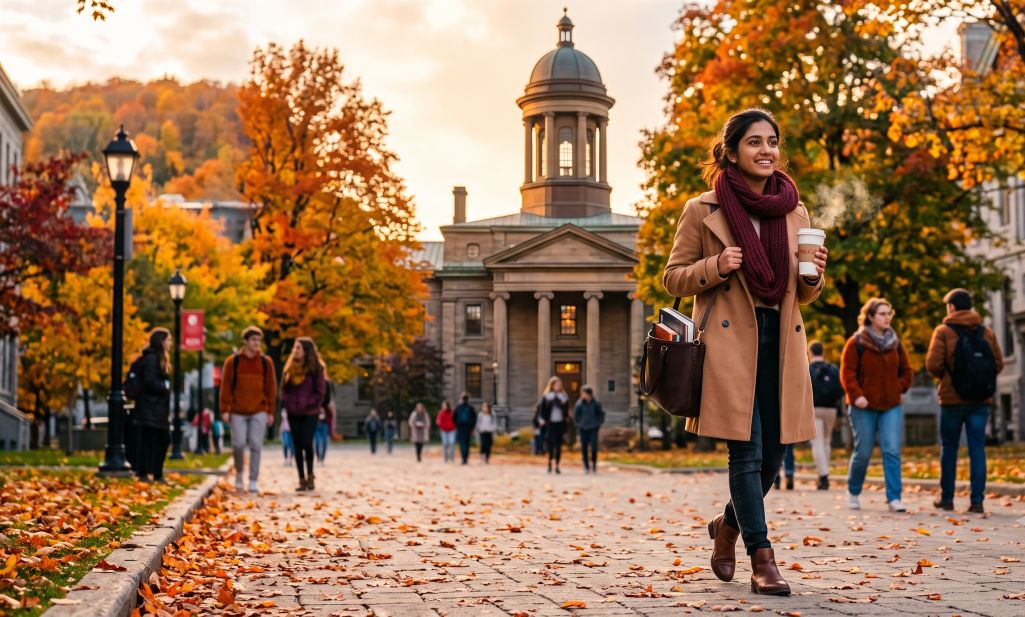
Study in Montreal
Table of Contents
- Why Studying in Montreal is a Right Choice for Indian Students
- Top Universities to Study in Montreal for Indian Students in 2026
- Acceptance Rate in Montreal Universities for Indian Students in 2026
- Popular Courses to Study in Montreal for Indian Students in 2026
- Admission Requirements for Study in Montreal in 2026
- How to Apply to Study in Montreal
- Canada Study Visa Process for Studying in Montreal
- Cost of Studying in Montreal for Indian Students in 2026
- Cost of Living in Montreal for Indian Students in 2026
- Most Preferred Areas for Indian Students in Montreal
- Scholarships in Montreal for Indian Students in 2026
- PR and Settlement in Montreal for Indian Students in 2026
- Career Opportunities in Montreal for Indian Students in 2026
- Tips for Indian Students Planning to Study in Montreal
- Author's Thoughts
Studying in Montreal is highly popular due to its bilingual culture, affordable cost of living, and world-class education. The city consistently ranks as one of the best student cities globally and boasts a thriving tech and gaming industry, making it an excellent hub for post-graduation careers.
It is home to prominent institutions like McGill University, an internationally renowned English-language university; Université de Montréal, a French-language research university; and Concordia University, known for its experiential learning and fine arts.
Why Studying in Montreal is a Right Choice for Indian Students
Choosing to study in Montreal brilliantly merges academic programs with direct access to North America's financial and deep tech sectors. One of the key benefits of studying in Montreal is the thriving startup ecosystem that welcomes diverse international talent into prospective roles. When looking at the extensive benefits of studying in Montreal, the seamless transition into the corporate market easily stands out.
Thriving Tech Ecosystem: Montreal boasts a booming tech and gaming industry, acting as an exceptional hub for post-graduation careers.
Networking Potential: The city hosts numerous global AI and business summits, providing unparalleled opportunities to build relationships with industry leaders.
Pathways to PR: The province of Quebec offers dedicated immigration streams, such as the PEQ (Quebec Experience Program), which highly favors international graduates who learn French.
High Standard of Living: Students enjoy a world-class lifestyle with rent and tuition costs that are often significantly lower than in Toronto or Vancouver.
Cultural Diversity: The city is home to a massive, welcoming Indian community, providing easy access to familiar cultural festivals, groceries, and student networks.
We can also learn about the grading system of Montreal that gives a major boost to its value.
Credit & Grading System
Universities utilize a cumulative Grade Point Average (GPA) system alongside a standardized percentage scale.
The following table illustrates the standard grading methodology across major institutions.
Aspect | Details |
Grading Scale | A (Excellent: 80-100%), B (Good: 70-79%), C (Satisfactory: 60-69%), D (Marginal: 50-59%), F (Fail) |
Academic Load | Typically, 15 credits or 5 courses per semester for full-time students. |
Pass Requirement | A minimum cumulative GPA must be strictly maintained to graduate. |
Top Universities to Study in Montreal for Indian Students in 2026
Finding the best colleges to study in Montreal ensures you get unparalleled academic and industry exposure during your degree. Securing admission into these renowned hubs is a vital step when deciding to study in Montreal and planning your professional journey.
Universities for Engineering & Technology in Montreal
Engineering programs focus heavily on deep tech, artificial intelligence, and structural innovation.
The table below lists top engineering institutions with their global standings.
University | QS Global Rank (2027) | Annual Tuition (CAD) / (INR) |
McGill University | #30 | 55,000 CAD (₹3,674,000) |
Université de Montréal | #162 | 30,000 CAD (₹2,004,000) |
Concordia University | #497 | 35,000 CAD (₹2,338,000) |
Polytechnique Montréal | - | 29,000 CAD (₹1,937,200) |
École de technologie supérieure (ÉTS) | - | 25,000 CAD (₹1,670,000) |
Universities for Management in Montreal
Business schools are celebrated globally for dynamic programs deeply integrated with North America's financial sectors.
This table outlines prominent universities for business and management studies.
University | QS Global Rank (2027) | Annual Tuition (CAD) / (INR) |
McGill University (Desautels) | #30 | 60,000 CAD (₹4,008,000) |
Université de Montréal | #162 | 28,000 CAD (₹1,870,400) |
Concordia University (John Molson) | #497 | 32,000 CAD (₹2,137,600) |
HEC Montréal | - | 30,000 CAD (₹2,004,000) |
UQAM (University of Quebec in Montreal) | - | 24,000 CAD (₹1,603,200) |
Universities for MS Computer Science in Montreal
These pathways provide top-tier education for future data scientists aiming for a good job opportunity.
The following table showcases leading IT and computer science institutions.
University | QS Global Rank (2027) | Annual Tuition (CAD) / (INR) |
McGill University | #30 | 52,000 CAD (₹3,473,600) |
Université de Montréal | #162 | 26,000 CAD (₹1,736,800) |
Concordia University | #497 | 28,000 CAD (₹1,870,400) |
UQAM (University of Quebec in Montreal) | - | 23,000 CAD (₹1,536,400) |
École de technologie supérieure (ÉTS) | - | 25,000 CAD (₹1,670,000) |
Universities for Medicine & Life Sciences in Montreal
Medical and life science education focuses on advanced clinical training and cutting-edge biomedical startup research.
This table presents top-tier medical and life science faculties.
University | QS Global Rank (2027) | Annual Tuition (CAD) / (INR) |
McGill University | #30 | 70,000 CAD (₹4,676,000) |
Université de Montréal | #162 | 35,000 CAD (₹2,338,000) |
Concordia University | #497 | 30,000 CAD (₹2,004,000) |
UQAM (University of Quebec in Montreal) | - | 26,000 CAD (₹1,736,800) |
INRS (Institut national de la recherche scientifique) | - | 22,000 CAD (₹1,469,600) |
Acceptance Rate in Montreal Universities for Indian Students in 2026
Admission to the best colleges to study in Montreal relies heavily on meeting high academic thresholds. Comprehensive institutions utilize admission quotas tailored specifically to attract diverse international talent.
Here are approximate acceptance rates across different university tiers.
Tier | Rate Range | Examples |
Highly Selective (Elite) | 40–45% | McGill University |
Moderately Selective | 50–60% | Université de Montréal, HEC Montréal |
Accessible/Applied | 60–80% | Concordia University, UQAM |
Popular Courses to Study in Montreal for Indian Students in 2026
Given the dynamic market, students favor programs in Digital Marketing, Corporate Finance, and Data Science. Exploring these specific disciplines is one of the main benefits of studying in Montreal due to high graduate employability.
The table highlights the most popular programs and approximate financial commitments.
Course | University Options | Average Annual Tuition Range |
Corporate Finance (MS / MBA) | McGill University
HEC Montréal
Concordia University | 55,000 – 65,000 CAD (₹3,674,000 – ₹4,342,000)
30,000 – 35,000 CAD (₹2,004,000 – ₹2,338,000)
28,000 – 34,000 CAD (₹1,870,400 – ₹2,271,200) |
Computer Science & AI | McGill University
Polytechnique Montréal
Concordia University | 45,000 – 55,000 CAD (₹3,006,000 – ₹3,674,000)
28,000 – 33,000 CAD (₹1,870,400 – ₹2,204,400)
25,000 – 30,000 CAD (₹1,670,000 – ₹2,004,000) |
Data Science & Business Analytics | McGill University
Université de Montréal
HEC Montréal | 48,000 – 58,000 CAD (₹3,206,400 – ₹3,874,400)
24,000 – 28,000 CAD (₹1,603,200 – ₹1,870,400)
28,000 – 32,000 CAD (₹1,870,400 – ₹2,137,6000 |
Supply Chain Management | McGill University
HEC Montréal
Concordia University | 45,000 – 52,000 CAD (₹3,006,000 – ₹3,473,600)
28,000 – 34,000 CAD (₹1,870,400 – ₹2,271,200)
26,000 – 31,000 CAD (₹1,736,800 – ₹2,070,800) |
Aerospace Engineering | McGill University
Concordia University
Polytechnique Montréal | 50,000 – 58,000 CAD (₹3,340,000 – ₹3,874,400)
28,000 – 36,000 CAD (₹1,870,400 – ₹2,404,800)
27,000 – 33,000 CAD (₹1,803,600 – ₹2,204,400) |
Digital Marketing & SEO | Concordia University
HEC Montréal
UQAM (ESG UQAM) | 26,000 – 32,000 CAD (₹1,736,800 – ₹2,137,600)
28,000 – 34,000 CAD (₹1,870,400 – ₹2,271,200)
22,000 – 26,000 CAD (₹1,469,600 – ₹1,736,800) |
Business Administration (MBA) | McGill University
HEC Montréal
Concordia University | 65,000 – 75,000 CAD (₹4,342,000 – ₹5,010,000)
55,000 – 65,000 CAD (₹3,674,000 – ₹4,342,000)
35,000 – 42,000 CAD (₹2,338,000 – ₹2,805,600) |
Admission Requirements for Study in Montreal in 2026
Securing admission demands a pristine academic background, verified credential evaluations, and proven language proficiency. This strictly streamlined process is essential for those who want to study in Montreal.
Eligibility by Degree Level
Academic prerequisites scale strictly according to the complexity and level of the desired degree program. The table outlines standard eligibility criteria for different study levels.
Level | Academic Requirement | Key Notes |
Bachelor’s | 12th Grade completion with a minimum of 75% overall. | Requires specific math prerequisites for business programs. |
Master’s | Strong 4-year Bachelor's degree (B+ average). | Strict requirement for matching undergraduate credits. |
Doctorate (PhD) | Excellent Master's record with published research. | Must secure a faculty supervisor prior to applying. |
Required Documents
International applicants must compile a file containing verified academic, professional, and financial documents. This table lists the essential paperwork needed for applications.
Category | Items Needed |
Academic | Transcripts, degree certificates, and an ECA (Educational Credential Assessment). |
Personal & Professional | Valid passport, highly tailored SOP, LORs, and a refined professional Resume/CV. |
Financial | Proof of funds (GIC) covering first-year tuition and standard living expenses. |
Standardized Tests
Standardized testing is frequently required for competitive programs to definitively prove academic readiness.
The following table clarifies common standardized testing requirements.
Exam | Level | Notes |
GRE | PG (Master's) | Highly recommended for competitive deeptech, engineering, and IT programs. |
GMAT | PG (MBA) | Mandatory for top management and venture capital programs at elite schools. |
Language Proficiency
Students must prove high language proficiency to handle rigorous academic coursework effectively.
Here are the common language requirements for university courses.
Test | Competitive Scores (2026) |
IELTS Academic | 6.5–7.0 overall (No individual band less than 6.0) |
TOEFL iBT | 88–100 overall (With specific minimums in writing and speaking) |
TEF/TCF (French) | B2 level for francophone institutions |
How to Apply to Study in Montreal
Applying to study in Montreal requires planning and a clear understanding of both academic and provincial requirements. International students must successfully secure university admission before navigating Quebec's unique two-step student visa process. Following a highly structured timeline ensures you comfortably meet all mandatory deadlines for a seamless transition.
Choose a Designated Learning Institution (DLI): Carefully research and shortlist universities or applied colleges in Montreal that are officially recognized by the government to host international students.
Submit Your Academic Application: Prepare and submit your verified academic transcripts, valid language test scores (IELTS/TOEFL/TEF), a tailored Statement of Purpose (SOP), and strong Letters of Recommendation (LORs) prior to the specific intake deadlines.
Obtain a Quebec Acceptance Certificate (CAQ): Immediately after receiving your official Letter of Acceptance from the university, you must apply for a CAQ, which is a mandatory provincial approval step unique to Quebec.
Apply for a Canadian Study Permit: Once your CAQ is fully approved, submit your application for a federal study permit through the IRCC portal, providing your Guaranteed Investment Certificate (GIC) and necessary medical records.
Finalize Your Arrival Plans: After your visa is stamped, securely arrange your shared student housing, book your flights, and pack all your original, physical documents to present to border officials upon entry
Canada Study Visa Process for Studying in Montreal
Students must sequentially obtain a Quebec Acceptance Certificate (CAQ) and a Canadian Study Permit to legally study in Montreal. Understanding this dual sequence is vital to study in Montreal for international students.
For most students, an approved CAQ serves as the required provincial attestation for the federal application. However, as of January 1, 2026, students enrolled in Master's and Doctoral degree programs at publicly Designated Learning Institution (DLIs) are exempt from the national PAL cap, though they are still strictly required to obtain a CAQ.
This table breaks down the steps to secure a Student Visa.
Step | Requirement | Details |
1 | Letter of Acceptance | Obtain an official admission letter from a Designated Learning Institution (DLI). |
2 | Apply for CAQ | Secure a Quebec Acceptance Certificate from the provincial government. |
3 | GIC Deposit | Deposit 20,635 CAD (₹1,378,418) into a GIC to prove funds for living costs. |
4 | Apply Online | Submit your complete application via the official IRCC secure portal. |
Cost of Studying in Montreal for Indian Students in 2026
A well-planned budget is crucial for those preparing to study in Montreal. While exploring the best colleges to study in Montreal, accurately calculating tuition prevents unforeseen financial strain.
Tuition Fees (Semester Wise)
Universities generally bill their substantial international tuition charges on a per-semester basis. The table shows approximate semester-wise splits for full-time programs.
Institution Type | Per Semester (CAD) / INR | Annual (CAD) / INR |
Top-Tier Universities | 25,000 CAD (₹1,670,000) | 50,000 CAD (₹3,340,000) |
Applied Colleges | 15,000 CAD (₹1,002,000) | 30,000 CAD (₹2,004,000) |
Tuition Fees (Course Wise)
Elite MBA and medical degrees involve the highest fees, while applied digital diplomas remain highly affordable. This table compares average annual fees by academic discipline.
Course & University | Annual Tuition Range (CAD) | Annual Tuition Range (INR) |
Engineering / Technology at McGill University | 50,000 – 58,000 CAD | ₹3,340,000 – ₹3,874,400 |
Engineering / Technology at Concordia University | 28,000 – 36,000 CAD | ₹1,870,400 – ₹2,404,800 |
Computer Science / IT at McGill University | 45,000 – 55,000 CAD | ₹3,006,000 – ₹3,674,000 |
Computer Science / IT at Université de Montréal | 24,000 – 28,000 CAD | ₹1,603,200 – ₹1,870,400 |
Management / MBA at McGill University (Desautels) | 65,000 – 75,000 CAD | ₹4,342,000 – ₹5,010,000 |
Management / MBA at Concordia University (John Molson) | 35,000 – 42,000 CAD | ₹2,338,000 – ₹2,805,600 |
Digital Marketing & SEO at HEC Montréal | 28,000 – 34,000 CAD | ₹1,870,400 – ₹2,271,200 |
Artificial Intelligence & Deeptech at Université de Montréal | 24,000 – 28,000 CAD | ₹1,603,200 – ₹1,870,400 |
Aerospace Engineering at Polytechnique Montréal | 27,000 – 33,000 CAD | ₹1,803,600 – ₹2,204,400 |
Cost of Living in Montreal for Indian Students in 2026
The city is a prosperous economic hub, yet its housing costs remain significantly lower than standard Canadian averages. It is a core factor when determining how to study in Montreal for international students on a strict budget.
Here is a breakdown of typical monthly expenses for a student.
Expense | Monthly Cost (CAD) | Monthly Cost (INR) |
Housing (Shared Apartment) | 600–900 CAD | ₹40,080–₹60,120 |
Food & Groceries | 300–400 CAD | ₹20,040–₹26,720 |
Health Insurance | 60–80 CAD | ₹4,008–₹5,344 |
Transportation (STM Pass) | 60 CAD | ₹4,008 |
Source: Numbeo
Most Preferred Areas for Indian Students in Montreal
Indian students typically choose lively neighborhoods that perfectly balance affordability with campus proximity and transport facilities.
Finding the ideal local community greatly enhances the student experience at the best colleges to study in Montreal.
Downtown Core: Perfect for finance and business students who want to live steps away from major consulting firms.
The Plateau: A culturally rich, artistic hub favored its dynamic energy and bilingual community.
Notre-Dame-de-Grâce (NDG): Highly popular among English-speaking students due to its residential feel and proximity to Concordia.
Mile End: Known globally for its thriving tech startup scene and excellent coffee shops.
LaSalle: Features a large multicultural population, highly affordable rent, and excellent access to the Angrignon metro station.
Brossard: A thriving suburban area on the South Shore, popular for families and mature students seeking larger spaces and quieter study environments.
Saint-Laurent: Known for its massive industrial parks, making it ideal for engineering and supply chain students seeking local co-ops.
Scholarships in Montreal for Indian Students in 2026
Scholarships provide crucial financial support to securely cover living and academic costs. Securing merit-based aid will greatly assist those eager to study in Montreal without accumulating excessive debt. Here are the top scholarships available for incoming international students.
Scholarship Name | Main Eligibility | Scholarship Amount & Details |
McCall MacBain Scholarships | Exceptional academic achievement (McGill) | Covers full tuition and a living stipend. |
UdeM Exemption Scholarship | High academic average for international students | Reduces international tuition to the domestic rate. |
Concordia Presidential Scholarship | Academic excellence and leadership | Covers tuition, fees, books, and living costs. |
Quebec Merit Scholarship (PBEEE) | Outstanding international researchers | Up to 25,000 CAD (₹1,670,000) per year for PhDs. |
HEC Montréal Entrance Scholarships | Top applicants to business programs | Up to 10,000 CAD (₹668,000) for high-achieving students. |
How to Apply to Scholarships for Indian Students
Scholarship applications require a pristine academic profile and proactive preparation independent of your university admission. The table outlines the general scholarship application roadmap.
Step | Action | Timeline |
1. Research | Check university portals for strict deadlines and specific criteria. | 10–12 months before intake |
2. Prepare Documents | Gather strong LORs and a tailored motivation letter. | Aug–Oct (for Fall intake) |
3. Submit Application | Apply directly through the specific scholarship portal. | Nov–Jan |
PR and Settlement in Montreal for Indian Students in 2026
The region offers a highly structured pathway for graduates to secure Permanent Residency through dedicated provincial programs. Long-term security is a major reason why many choose to study in Montreal.
Pathway from Student to PR
Transitioning to permanent residency requires systematic planning and consistent contributions to the local economy after graduation.
Acquire a PGWP: Secure an open post-graduation work permit to immediately gain vital local work experience.
Learn French: Reaching a B2 proficiency in conversational French is often a strict requirement for Quebec's permanent residency programs.
Apply for PEQ (Quebec Experience Program): Utilize this fast-track program specifically designed for international students who have successfully graduated in Quebec.
Secure the CSQ: Obtain a Certificat de sélection du Québec, which serves as provincial nomination before you apply for federal residency.
Maintain Skilled Employment: Hold a job categorized as TEER 0, 1, 2, or 3 to effectively demonstrate your long-term economic establishment.
Career Opportunities in Montreal for Indian Students in 2026
The robust industrial ecosystem and rapidly growing tech sector offer phenomenal career prospects. Anyone aiming to study in Montreal for international students should thoroughly analyze these highly lucrative career pathways before enrolling.
Top Job Roles and Salary
Graduates can expect highly competitive starting salaries and rapid corporate career progression across various sectors. This table highlights top entry-level roles and their expected earning potential.
Job Role / Title | Average Annual Salary (CAD) | Average Annual Salary (INR) |
Financial Analyst | $58,627 and $85,078 | ₹4,018,000–₹5,848,000 |
AI / Data Scientist | 75,000–115,000 CAD | ₹5,010,000–₹7,682,000 |
Software Engineer | 70,000–110,000 CAD | ₹4,676,000–₹7,348,000 |
Digital Marketing Manager | 55,000–85,000 CAD | ₹3,674,000–₹5,678,000 |
Aerospace Engineer | 75,000–110,000 CAD | ₹5,010,000–₹7,348,000 |
Supply Chain Analyst | 52,000–80,000 CAD | ₹3,473,600–₹5,344,000 |
Clinical Research Associate | 58,000–88,000 CAD | ₹3,874,400–₹5,878,400 |
Source: Glassdoor Canada 2026
In-Demand Domains as per the Current Market Scenario
Adapting to market needs is vital to maximize your post-graduation success and secure high-paying roles.
Artificial Intelligence & Deeptech: Montreal is a globally recognized AI business nursery, massively recruiting specialized data scientists and machine learning engineers.
Digital Media & Gaming: With major international studios operating locally, opportunities in 3D animation, game development, and digital marketing are abundant.
Corporate Finance & Valuations: Leading global consultancies and venture capital firms continuously seek analysts capable of complex financial modeling and pitching.
Aerospace Engineering: The city is home to several aerospace giants, creating sustained, high demand for specialized structural engineers and supply chain managers.
Healthcare & Life Sciences: Expanding biomedical startups and pharmaceutical hubs consistently hire specialized clinical researchers and biomedical technicians.
Tips for Indian Students Planning to Study in Montreal
Adapting to a fast-paced corporate environment requires strategic preparation and professional knowledge. Utilizing these tips when you study in Montreal will position you for academic success and rapid career progression.
Master the French Language: While you can easily live and study in English, achieving French fluency opens significantly more job doors and drastically expedites your PR application.
Leverage Campus Networking Events: Maximize your presence at university tech summits and business pitch events to personally connect with venture capitalists and leading industry recruiters.
Dress for Extreme Winters: Invest heavily in high-quality, insulated winter gear before your arrival, as local temperatures routinely drop well below freezing.
Target Co-op Programs: Prioritize working student positions and internships during your degree to gain paid corporate experience and build a localized professional resume.
Secure Housing Early: Explore neighborhoods along the major metro lines well before your arrival to lock in affordable and convenient shared student housing.
Author's Thoughts
Deciding to study in Montreal is a brilliant move for Indian students who are eager to bridge academics with corporate exposure. The city provides graduates with a booming and talent-hungry job market. One of the greatest benefits of studying in Montreal is an amazing return on investment compared to other top-tier cities.
The best colleges to study in Montreal offer advanced tools and deep tech integration to truly set you apart. By proactively upskilling, those who choose to study in Montreal pave a streamlined pathway to permanent residency in a metropolis with a good standard of living for Indians.
Ready to embark on your academic journey in Montreal? Connect with our experts to know about concerned universities, courses, scholarships, admissions, and career opportunities.