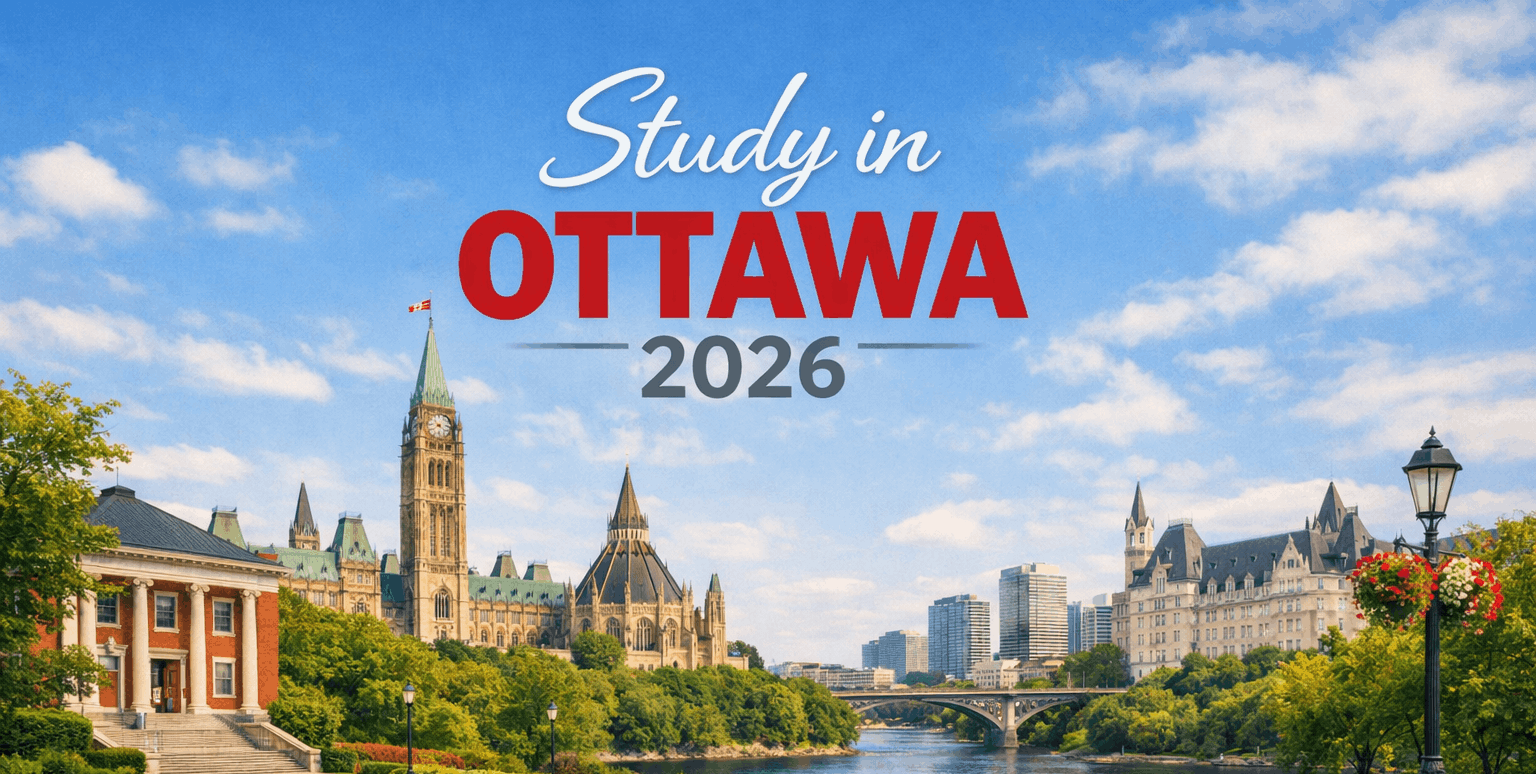
Study in Ottawa in 2026
Table of Contents
- Why Study in Ottawa?
- Top Universities to Study in Ottawa
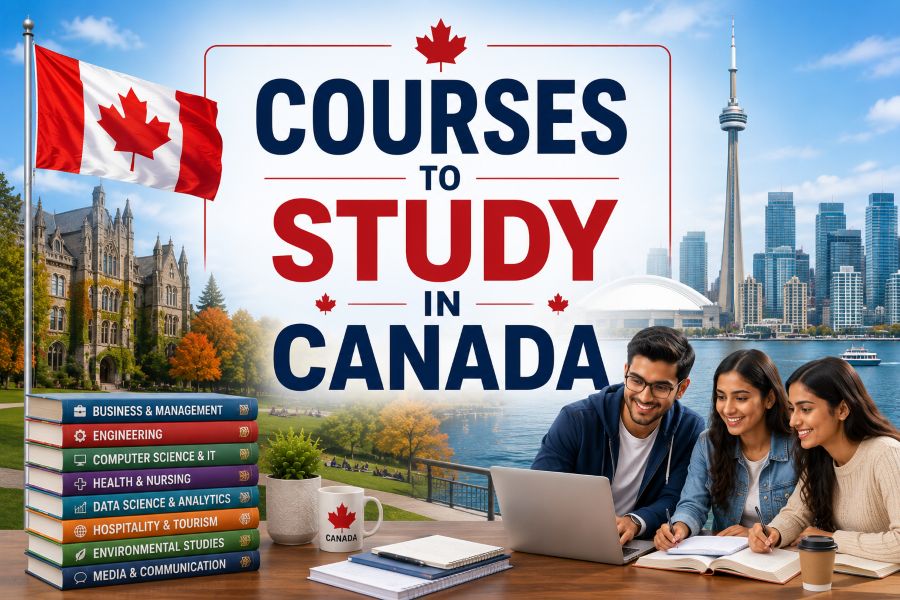
- Best Courses to Study in Ottawa
- Eligibility and Admission Requirements to Study in Ottawa
- Cost of Study in Ottawa
- Top Scholarships to Study in Ottawa
- Intakes and Application Timeline for Study in Ottawa
- How to Apply to Study in Ottawa
- Student Visa Requirements for Study in Ottawa
- Work Opportunities While Studying in Ottawa
- Job Opportunity in Canada After Studying in Ottawa
- Author's POV
Study in Ottawa gives international students the opportunity to earn a globally recognised degree in Canada's capital city, home to leading institutions such as the University of Ottawa and Carleton University. Known for its safe environment, strong research ecosystem, and excellent graduate employment opportunities, Ottawa is a popular destination for students across engineering, business, computer science, public policy, and health sciences.
International tuition fees generally range from CAD 20,000–45,000 per year (approx. INR 12.4L–27.9L), while annual living expenses are around CAD 14,000–20,000 (approx. INR 8.68L–12.4L). Choosing to study in Ottawa means gaining access to quality education, multicultural experiences, and strong career opportunities in Canada's growing economy.
Key Highlights of Study in Ottawa:
Key Highlights | Details |
Top Universities | University of Ottawa (uOttawa), Carleton University |
Top Colleges | Algonquin College, Collège La Cité |
Course Duration | 1 to 2 years postgraduate; 3 to 4 years undergraduate |
Popular Fields | Law, Public Policy, Health Sciences, Engineering, Computer Science, Environmental Studies, Business |
Tuition Fees | CAD 20,000–45,000/year (approx. Rs. 12.4L–Rs. 27.9L) |
Living Expenses | CAD 14,000–20,000/year (approx. Rs. 8.68L–Rs. 12.4L) |
Post-Study Work Option | Post-Graduation Work Permit (PGWP) up to 3 years |
Language of Instruction | English and French; most international programmes in English |
Why Study in Ottawa?
Beyond institutional academic rankings, Canada’s capital city offers a unique combination of financial predictability, strategic employer proximity, and professional growth for international students. Choosing to study in Ottawa means moving into a highly functional metropolitan ecosystem where higher education is explicitly designed to meet the demands of the Canadian workforce.
Canada's Largest Tech Cluster: Ottawa houses the Kanata North Technology Park, a massive economic hub featuring hundreds of companies driving cloud computing, cybersecurity, and software engineering. Global tech giants like Nokia and Ericsson, alongside local icons like Shopify, actively recruit talent directly from the city's student talent pool.
Systemic Co-op Advantages: The city's educational architecture prioritizes career integration over pure theory. Higher education institutions throughout the capital maintain deep, systemic partnerships with private tech and corporate sectors, producing robust co-op placement rates that consistently exceed 90 percent.
A Geographical Monopoly on Careers: For students targeting public policy, international law, health sciences, and environmental resource sectors, the capital offers unmatched networking. As the seat of federal government networks, research institutes, and international embassies, it places students next to the country's largest institutional employers.
The Bilingual Career Edge: Operating smoothly in both English and French, Ottawa offers a multicultural professional environment. Navigating this bilingual corporate landscape expands a student's communication versatility and unlocks career avenues in global consulting firms and NGOs that unilingual regions cannot duplicate.
Flexible Educational Pathing: The capital stands out for its balanced mix of academic options. Whether an international applicant is seeking high-tier research degrees, specialized professional diplomas, or fast-tracked technical graduate certificates, the city offers an institution to match any timeline or budget.
Sustainable Cost of Living: Managing a student budget is noticeably easier in Ottawa compared to tier-one Canadian cities like Toronto or Vancouver. Lower average housing costs and student transit options mean your financial resources stretch much further during your crucial initial job search window.
Is Study in Ottawa Worth It?
Yes, study in Ottawa is a great choice for students looking for quality education, strong career opportunities, and a high quality of life. As Canada's capital, Ottawa offers direct access to government organisations, leading technology companies, research centres, and multinational employers. The city is especially popular for programmes in engineering, business, computer science, public policy, health sciences, and law. Compared to cities like Toronto and Vancouver, Ottawa also offers a more affordable cost of living while maintaining excellent graduate employment prospects.
Also read: Free Education in Canada for Indian Students
Top Universities to Study in Ottawa
Ottawa features a balanced, collaborative educational ecosystem composed of world-class research universities and top-tier public applied colleges. Because all these primary institutions hold Designated Learning Institution (DLI) status, international students have full access to the Post-Graduation Work Permit (PGWP) pathway upon completing their credentials, whether they pursue a theoretical degree or a hands-on technical diploma
University | QS World Ranking 2027 | Known For |
University of Ottawa (uOttawa) | #228 globally | Law, Public Policy, Health Sciences, Engineering, Business, Bilingual Education |
Carleton University | #601–650 globally | Journalism, Public Affairs, Engineering, Cognitive Science, Computer Science |
Note:
The University of Ottawa is the largest bilingual English-French university in the world, located in the Canadian capital city, and is a member of the U15, a cluster of research-intensive institutions in Canada.
Carleton University complements uOttawa particularly well in journalism, public affairs, and applied engineering, making Ottawa as a city one of the more well-rounded academic environments among Canadian university cities of comparable size.
Top Colleges to Study in Ottawa
For many Indian students, choosing a public college over a university is a strategic career move to maximize ROI. Rather than focusing on heavy academic theory, Ottawa's public colleges emphasize practical, hands-on skills, mandatory co-op placements, and quick entry into the Canadian workforce. Crucially for Indian applicants planning their long-term path, these institutions are Designated Learning Institutions (DLIs), meaning their full-time diplomas and post-graduate certificates satisfy the Post-Graduation Work Permit (PGWP) eligibility framework.
The table below breaks down the top public colleges in Ottawa:
Institution | Key Program Strengths | Estimated Annual Tuition (INR & CAD) |
Algonquin College | Cloud Development, Cyber Security, Business Analytics, Project Management, Engineering Technology | CAD 16,000 – CAD 22,000
(Approx. ₹9.9 Lakh – ₹13.6 Lakh) |
Collège La Cité | Computer Programming, Biotechnology, Health Sciences, Graphic Design, Business Administration | CAD 16,500 – CAD 21,000
(Approx. ₹10.2 Lakh – ₹13.0 Lakh) |
Best Courses to Study in Ottawa
The most strategic courses to study in Ottawa reflect the capital’s high-income sectors: public policy, engineering, commercial tech, and specialized healthcare. For Indian students, choosing a field in Ottawa is highly unique because the programs at both public colleges and universities connect directly to employers located minutes from the campuses.
Furthermore, college programs are closely aligned with Canada's IRCC high-demand occupational pathways, ensuring that technical diplomas and post-graduate certificates remain robust launchpads for a Post-Graduation Work Permit (PGWP) and future permanent residency.
Law and Public Policy Courses
Ottawa is Canada's legal and policy capital, which makes it uniquely suited for law and public policy studies. Students here have access to federal courts, parliamentary committees, and policy organisations that no other Canadian city can match.
Course | University | Approx. Annual Tuition |
JD Common Law | University of Ottawa | CAD 22,440/year (approx. Rs. 13.91L) |
LLM International Law | University of Ottawa | CAD 8,568/year (approx. Rs. 5.31L) |
MPA Master of Public Administration | University of Ottawa (Telfer) | CAD 24,000–30,000/year (approx. Rs. 14.88L–Rs. 18.6L) |
MA Political Science | Carleton University | CAD 8,000–12,000/year (approx. Rs. 4.96L–Rs. 7.44L) |
Graduate Diploma in Public Policy | Carleton University | CAD 10,000–15,000/year (approx. Rs. 6.2L–Rs. 9.3L) |
PG Certificate in Public Administration | Algonquin College | CAD 17,225 / year (approx. ₹10.68 Lakh) |
Health Sciences and Medicine Courses
Health sciences at uOttawa benefit from partnerships with The Ottawa Hospital and affiliated research institutes, giving students direct clinical and research exposure. Ottawa is also one of the best places in Canada to study Physician Assistant programmes and public health.
Studying Physician Assistant in Canada Ottawa is one of the more competitive pathways available, with uOttawa offering one of the few accredited PA programmes in the country. Students in health sciences also benefit from the university's Advanced Medical Research Centre.
Course | University | Approx. Annual Tuition |
MSc Epidemiology | University of Ottawa | CAD 8,568–12,000/year (approx. Rs. 5.31L–Rs. 7.44L) |
MSc Health Systems | University of Ottawa | CAD 8,568–12,000/year (approx. Rs. 5.31L–Rs. 7.44L) |
Physician Assistant Program | University of Ottawa | CAD 25,000–35,000 total programme (approx. Rs. 15.5L–Rs. 21.7L) |
MSc Public Health | University of Ottawa | CAD 8,568–12,000/year (approx. Rs. 5.31L–Rs. 7.44L) |
BHSc Health Sciences | University of Ottawa | CAD 28,000–35,000/year (approx. Rs. 17.36L–Rs. 21.7L) |
Environmental Studies Courses in Ottawa
Environmental studies in Ottawa benefit from proximity to federal government departments including Environment and Climate Change Canada, Natural Resources Canada, and the National Capital Commission. These organisations recruit actively from uOttawa and Carleton's environmental programmes.
Environmental Studies courses in Ottawa are among the more practically connected programmes available at Canadian universities, because the agencies that shape Canadian environmental policy are located in the same city as the campuses where students are studying. This creates internship, co-op, and post-graduation employment access that is simply unavailable at environmental programmes located further from the federal government cluster.
Course | University | Approx. Annual Tuition |
MSc Earth Sciences | University of Ottawa | CAD 8,568–12,000/year (approx. Rs. 5.31L–Rs. 7.44L) |
MSc Environmental Studies | University of Ottawa | CAD 8,568–12,000/year (approx. Rs. 5.31L–Rs. 7.44L) |
MA Geography and Environmental Studies | Carleton University | CAD 8,000–12,000/year (approx. Rs. 4.96L–Rs. 7.44L) |
BSc Environmental Science | University of Ottawa | CAD 28,000–35,000/year (approx. Rs. 17.36L–Rs. 21.7L) |
Engineering and Computer Science Courses
Engineering and computer science programmes at both uOttawa and Carleton benefit from Ottawa's Kanata North technology park, which is home to over 1,700 technology companies and provides one of the most active co-op and graduate hiring environments for engineering and CS graduates in Canada.
Course | University | Approx. Annual Tuition |
MEng Electrical Engineering | University of Ottawa | CAD 8,568–12,000/year (approx. Rs. 5.31L–Rs. 7.44L) |
MSc Computer Science | University of Ottawa | CAD 8,568–12,000/year (approx. Rs. 5.31L–Rs. 7.44L) |
MEng Software Engineering | Carleton University | CAD 10,000–15,000/year (approx. Rs. 6.2L–Rs. 9.3L) |
MEng Systems and Computer Engineering | Carleton University | CAD 10,000–15,000/year (approx. Rs. 6.2L–Rs. 9.3L) |
3-Year Advanced Diploma in Computer Engineering Tech | Algonquin College | CAD 18,500 / year (approx. ₹11.47 Lakh) |
1-Year PG Certificate in Cloud Development & Operations | Algonquin College | CAD 17,500 / year (approx. ₹10.85 Lakh) |
Eligibility and Admission Requirements to Study in Ottawa
Admission requirements in Ottawa are structured to accommodate both academic, research-intensive university pathways and hands-on, applied college programs. Ottawa's public institutions evaluate candidates based on prior academic marks, credential duration, and English (or French) language proficiency, with requirements varying significantly depending on whether you apply to a university or a college.
Academic Requirements
For Indian students, academic eligibility is mapped directly to standard Indian grading systems (CBSE, CISCE, or State Boards for high school, and UGC-recognized universities for degree holders).
The table below outlines the core academic prerequisites across Ottawa's higher education spectrum:
Institution Tier & Program Level | Minimum Indian Academic Requirement | Key Notes for Indian Applicants |
Universities: Undergraduate (Bachelor's Degrees) | 75% to 85% in Class 12th board exams, depending on the program. | Math and science prerequisites are strictly evaluated for Engineering and Computer Science streams. |
Universities: Postgraduate (Master's / PG Diplomas) | First Division (typically 60% – 70%) or a minimum B-grade average in a relevant 4-year Bachelor's degree. | Some professional programs (such as Law or MBA) may accept a 3-year Indian bachelor's degree with a high GPA, but most require a 4-year program. |
Colleges: Undergraduate (Diplomas & Advanced Diplomas) | 55% to 60% overall in Class 12th board exams. | Highly accessible entry criteria; core subject backlogs must be kept to a minimum. |
Colleges: Postgraduate (PG Certificates) | 50% to 55% overall in a 3-year or 4-year Bachelor's degree. | Highly popular pathway for Indian graduates looking to pivot into applied fields like Project Management or Cybersecurity. |
English Language Requirements
While Ottawa operates as a bilingual capital, the vast majority of international programs are delivered entirely in English. If you choose a French-taught path, you will need to provide standard French evaluation scores (such as DALF C1).
For English-language programs, the requirements are:
University Level (Direct Entry): A minimum IELTS Academic score of 6.5 (with no individual band below 6.0) or an equivalent TOEFL iBT score of 86. Some highly competitive master’s degrees, especially in Law, may demand an IELTS score of 7.0.
College Diploma Level: A minimum IELTS Academic score of 6.0 (with no band lower than 5.5) or a TOEFL iBT score of 80.
College Post-Graduate Certificate Level: Requires a slightly higher IELTS Academic score of 6.5 (with no individual band below 6.0) or a TOEFL iBT score of 88.
Other Application Documents Required
Gathering your complete application packet early is critical to secure both your admission offer and your subsequent Provincial Attestation Letter (PAL) required for the Canadian study permit.
Academic Transcripts: Coloured scanned copies of your 10th and 12th marksheets, alongside individual semester-wise university transcripts (consolidated marksheets are often not accepted on their own by admissions boards).
Statement of Purpose (SOP): A highly personalized letter explaining your academic background, your reasoning for choosing Ottawa specifically over other Canadian cities, and how this particular program fits your long-term career roadmap back in India.
Letters of Recommendation (LORs): Two to three letters from academic professors or professional employers who can vouch for your work ethic and research capabilities.
Backlog Certificate: Required specifically by colleges when applying with an Indian bachelor's degree, stating the exact history of backlogs (cleared or active) during your previous studies.
Updated Resume (CV): Highlighting any relevant internship, research, or work experienc; especially valuable if you have a gap year in your academic history.
Must check: Education Loan for Study in Canada
Cost of Study in Ottawa
One of the more practical reasons to Study in Ottawa is that it is considerably more affordable than Toronto or Vancouver, both in terms of tuition and day-to-day living. That lower cost base matters a lot when you are budgeting across a one- or two-year programme.
Tuition Fees at Ottawa Educational Institutions
One of the most practical reasons to study in Ottawa is its significant affordability advantage compared to major Canadian hubs like Toronto or Vancouver. This lower baseline cost is a massive benefit for Indian families planning their education budgets, as it dramatically lowers the initial capital needed for both annual tuition fees and day-to-day student expenses.
Programme Level and Field | University | Approx. Annual Tuition (International) |
Graduate Research (MSc, MA, MEng) | University of Ottawa | CAD 8,568–12,000/year (Rs. 5.31L–Rs. 7.44L/year) |
Graduate Professional (MBA, MPA, JD) | University of Ottawa (Telfer/Law) | CAD 22,000–35,000/year (Rs. 13.64L–Rs. 21.7L/year) |
Undergraduate Programmes | University of Ottawa | CAD 28,000–38,000/year (Rs. 17.36L–Rs. 23.56L/year) |
Graduate Research (MSc, MA, MEng) | Carleton University | CAD 8,000–15,000/year (Rs. 4.96L–Rs. 9.3L/year) |
Undergraduate Programmes | Carleton University | CAD 22,000–32,000/year (Rs. 13.64L–Rs. 19.84L/year) |
Diplomas & PG Certificates | Algonquin College / La Cité | CAD 16,000 – CAD 22,000 (₹9.9 Lakh – ₹13.6 Lakh) |
Cost of Living in Ottawa
Ottawa is noticeably more affordable than Toronto or Vancouver for students managing monthly expenses. Accommodation is the largest single cost, and students who share housing keep their overall budget well within manageable limits.
Expense Category | Approx. Monthly Cost | INR Value |
Accommodation | CAD 800–1,400/month | Rs. 49,600–Rs. 86,800/month |
Food and Groceries | CAD 300–500/month | Rs. 18,600–Rs. 31,000/month |
Transport (OC Transpo Student Pass) | CAD 100–130/month | Rs. 6,200–Rs. 8,060/month |
Health Insurance (UHIP or equivalent) | CAD 600–900/year | Rs. 37,200–Rs. 55,800/year |
Books and Personal Expenses | CAD 100–200/month | Rs. 6,200–Rs. 12,400/month |
Total Annual Living Cost | CAD 14,000–20,000/year | Rs. 8.68L–Rs. 12.4L/year |
Source: Numbeo
Financial Requirement: To obtain a Canadian Study Permit, international students must demonstrate access to at least CAD 20,635 per year in financial resources to cover living costs, in addition to tuition fees.
Must check: Cost of MBA in Canada for Indian Students in 2026
Top Scholarships to Study in Ottawa
Offsetting the cost of international tuition becomes significantly easier through the regional funding matrix available in Canada’s capital. Ottawa's public institutions offer an array of entrance awards, merit scholarships, and specialized provincial funding for international applicants.
For Indian students, the key advantage is that most of these major institutional scholarships are automatic considerations; your standard application for admission acts as your direct evaluation for funding, eliminating the need for a separate application process.
The table below outlines the premier funding allocations open to international students across Ottawa’s educational sectors:
Scholarship / Award Name | Eligible Institutional Tiers | Average Value & Coverage |
Institutional Automatic Entrance Awards | All Public Universities & Colleges | CAD 1,000 – CAD 4,000 (Approx. ₹62,000 – ₹2.48 Lakh) Renewable based on annual GPA performance. |
President’s Welcome & Excellence Awards | Tier-1 Research Universities | CAD 2,000 – CAD 7,500 (Approx. ₹1.24 Lakh – ₹4.65 Lakh) Awarded to top-tier academic profiles upon entry. |
Ontario Graduate Scholarship (OGS) | University Masters / PhD Streams | CAD 10,000 – CAD 15,000 / year (Approx. ₹6.20 Lakh – ₹9.30 Lakh) Highly competitive, merit-based provincial grant. |
International Student Bursaries & In-Course Awards | Applied Public Colleges (Algonquin) | CAD 500 – CAD 2,500 (Approx. ₹31,000 – ₹1.55 Lakh) Evaluated based on financial need after semester one. |
Also check: Fully Funded Scholarships in Canada
Intakes and Application Timeline for Study in Ottawa
The standard Canadian academic calendar with September as the primary intake and a limited January option for select programmes. Planning your application timeline around these windows and getting documents ready early makes the process considerably less stressful.
Intake | Programme Start | Application Timeline |
September Intake (Main) | September | Applications typically open October prior year; most deadlines January to April |
January Intake (Limited) | January | Available for select programmes; applications open June to September |
May Intake (Limited) | May | Available at some undergraduate programmes; check directly with university |
Note:
September is the primary and most practical entry point for Study in Ottawa, offering the widest selection of programmes, the strongest scholarship availability, and the most co-op and internship cycle alignment.
Most scholarship deadlines for both uOttawa and Carleton fall between January and March, which means applying early in the September cycle gives you the best chance of being considered for merit funding alongside your admission offer.
How to Apply to Study in Ottawa
The application process for Study in Ottawa is straightforward but requires good organisation because several things happen at once. Getting your documents ready early, sitting language tests well before deadlines, and starting the Study Permit process as soon as your offer arrives all make the transition smoother.
Step | What to Do |
Step 1: Shortlist Programmes | Compare programmes at uOttawa and Carleton based on academic background, career goals, and budget |
Step 2: Check Eligibility | Review academic grade requirements, language score minimums, and programme prerequisites |
Step 3: Prepare Language Tests | Sit IELTS or TOEFL at least three months before application deadlines |
Step 4: Compile Documents | Gather transcripts, SOP, two to three LORs, CV, and passport |
Step 5: Submit Application | Apply through each university's official admissions portal; pay application fees |
Step 6: Apply for Scholarships | Submit scholarship applications alongside or immediately after admissions application |
Step 7: Accept Offer | Confirm place by accepting offer and paying enrolment deposit |
Step 8: Apply for Study Permit | Submit Canadian Study Permit application via IRCC with offer letter and financial proof |
Step 9: Arrange Pre-Departure | Book accommodation, organise health insurance, and prepare travel documents |
Student Visa Requirements for Study in Ottawa
International students admitted to a programme in Ottawa must apply for a Canada Study Visa (Study Permit) through IRCC before travelling. The permit process is the same regardless of which Ottawa university you attend and starting it as soon as your offer letter arrives avoids delays.
Requirement | Detail | Approx. Amount |
Offer Letter | From a Designated Learning Institution in Ottawa | Required |
Proof of Financial Capacity | Tuition plus living costs for first year | CAD 20,635/year (approx. Rs. 12.79L) |
Study Permit Application Fee | Paid online via IRCC portal | CAD 150 (approx. Rs. 9,300) |
Biometrics Fee | Required for most international applicants including Indian students | CAD 85 (approx. Rs. 5,270) |
Medical Examination | Required for applicants from certain countries including India | _ |
English Test Scores | IELTS or TOEFL as required by the programme | _ |
Academic Documents | Transcripts, degree certificates, test scores | _ |
Note: After completing their degree in Ottawa, eligible graduates can apply for a Post-Graduation Work Permit allowing up to three years of work authorisation in Canada. The PGWP is open, meaning no employer sponsorship is needed when the permit is first issued.
Work Opportunities While Studying in Ottawa
International students with a valid Canadian Study Permit can work part-time during the academic term and full-time during scheduled university breaks. Ottawa's job market for students is broader than people often expect, covering government roles, technology firms, retail, hospitality, and on-campus positions across both major universities.
Role | Work Limit | Approx. Hourly Rate |
Research Assistant | 20 hours/week during term | CAD 18–25/hour (approx. Rs. 1,116–Rs. 1,550/hour) |
Teaching Assistant | 20 hours/week during term | CAD 20–30/hour (approx. Rs. 1,240–Rs. 1,860/hour) |
Government Co-op or Internship | Program-specific; often full-time | CAD 18–28/hour (approx. Rs. 1,116–Rs. 1,736/hour) |
Campus or Admin Support | 20 hours/week during term | CAD 15–20/hour (approx. Rs. 930–Rs. 1,240/hour) |
Retail or Hospitality | 20 hours/week during term | CAD 16–18/hour (approx. Rs. 992–Rs. 1,116/hour) |
Note: uOttawa's co-op programme has a placement rate above 95 percent in government and technology roles, making it one of the strongest student work integration programmes at any Canadian university. Students should confirm their specific co-op eligibility and work permit conditions with their programme office before starting any role.
Job Opportunity in Canada After Studying in Ottawa
Job opportunities in Canada after studying in Ottawa are stronger than most students expect before they arrive. The federal government is the largest single employer in the city, but the Kanata North technology park, healthcare sector, law firms, and consulting organisations together create a diverse and active job market that goes well beyond public service.
Average salary in Canada after studying at University of Ottawa are particularly strong for law graduates, public policy specialists, health sciences professionals, and engineers, given the direct proximity of employers in all four fields. The PGWP gives graduates three years to build this experience before transitioning toward permanent residency through Express Entry or Ontario's provincial nominee programme.
Job Role | Approx. Annual Salary (CAD) | INR Value |
Government Policy Analyst | CAD 65,000–95,000 | Rs. 40.3L–Rs. 58.9L |
Software Engineer | CAD 80,000–120,000 | Rs. 49.6L–Rs. 74.4L |
Lawyer or Legal Counsel | CAD 80,000–130,000 | Rs. 49.6L–Rs. 80.6L |
Environmental Consultant | CAD 60,000–90,000 | Rs. 37.2L–Rs. 55.8L |
Physician Assistant | CAD 85,000–110,000 | Rs. 52.7L–Rs. 68.2L |
Health Sciences Professional | CAD 65,000–95,000 | Rs. 40.3L–Rs. 58.9L |
Data Analyst | CAD 70,000–100,000 | Rs. 43.4L–Rs. 62L |
Management Consultant | CAD 75,000–110,000 | Rs. 46.5L–Rs. 68.2L |
Source: Glassdoor
Author's POV
Choosing to study in Ottawa is less about chasing a famous city and more about finding the right balance between education, career opportunities, and affordability. Ottawa may not receive the same attention as Toronto or Vancouver, but it offers many of the same advantages with a lower cost of living and a more relaxed lifestyle. The city's strong government presence, growing tech sector, and excellent co-op opportunities make it particularly attractive for students planning to work in Canada after graduation.
Universities here also have strong research reputations and close ties with employers, helping students gain practical experience before entering the job market. If your goal is to earn a respected Canadian degree while managing your expenses and building long-term career prospects, study in Ottawa is a smart choice. It offers a practical path to quality education, valuable work experience, and a strong foundation for life in Canada.
Planning to Study in Ottawa? Speak with our study abroad experts for personalised guidance.