Study in Vancouver in 2026
Table of Contents
- Why Studying in Vancouver is a Right Choice for Indian Students
- Education System in Vancouver
- Top Universities to Study in Vancouver for Indian Students in 2026
- Acceptance Rate in Vancouver Universities for Indian Students in 2026
- Popular Courses to Study in Vancouver for Indian Students in 2026
- Admission Requirements for Study in Vancouver in 2026
- Student Visa Process in 2026
- Cost of Studying in Vancouver for Indian Students in 2026
- Cost of Living in Vancouver for Indian Students in 2026
- Scholarships in Vancouver for Indian Students in 2026
- How to Apply to Scholarships for Indian Students
- PR and Settlement in Vancouver for Indian Students in 2026
- Job Opportunities in Vancouver for Indian Students (2026)
- Tips for Indian Students Planning to Study in Vancouver
- Author's Final Thoughts
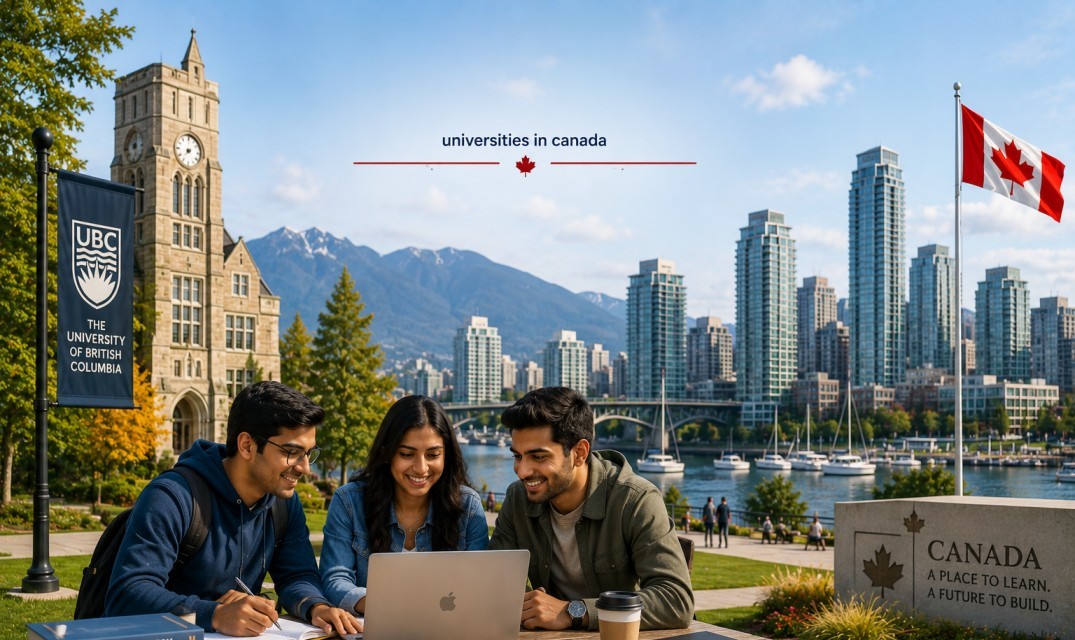
Studying in Vancouver offers Indian students a premier, world-class education at globally ranked universities alongside an outdoor-oriented, multicultural lifestyle with mild weather. In 2026, pursuing your dream degree here means planning for annual tuition fees that typically range from CAD $20,000 (INR 1,335,400) to CAD $60,000 (INR 4,006,200).
Additionally, living in this scenic city requires budgeting an extra CAD $2,000 (INR 133,540) to CAD $2,500 (INR 166,925) monthly for your vital living expenses and mandatory health insurance, creating a secure foundation for a rewarding international student journey.
The following table outlines the key highlights for international students looking to study in Vancouver in 2026.
Category | Details |
Top Universities | University of British Columbia (UBC), Simon Fraser University (SFU), British Columbia Institute of Technology (BCIT) |
Top Courses | Computer Science, Business Administration, Engineering, Digital Marketing |
Work Rules | Full-time students can legally work off-campus up to 20 hours/week during active academic terms. |
Settlement Pathway | Graduates can secure a Post-Graduation Work Permit (PGWP) for up to 3 years. |
Why Studying in Vancouver is a Right Choice for Indian Students
Vancouver brilliantly merges rigorous academic excellence with direct access to Canada's thriving tech, green energy, and digital media sectors. Indian students benefit from a high standard of living, breathtaking natural landscapes, and highly lucrative pathways into the North American corporate market.
Tech and AI Integration: Vancouver is a massive incubator for software and green technologies, offering abundant resources for innovation.
Global Trade Hub: The city's location on the Pacific Rim is perfect for supply chain and finance professionals looking to enter international trade.
Industry Networking: The city hosts numerous global tech and sustainability summits, providing unparalleled opportunities to exchange contact cards.
Post-Graduation Pathways: The region offers robust provincial nominee programs for seamless transitions into the Canadian workforce.
Massive Co-op Opportunities: Local universities heavily integrate paid corporate co-op placements, allowing Indian students to gain Canadian work experience before graduating.
Thriving Indian Community: The Greater Vancouver area hosts one of Canada's largest Indian diaspora communities, offering cultural familiarity, authentic food, and immense community support.
Exceptional Quality of Life: Vancouver consistently ranks among the world's most livable cities, known for safety, clean air, and world-class healthcare infrastructure.
Favorable Climate: Unlike the freezing temperatures of eastern Canada, Vancouver enjoys a moderate, temperate climate with mild winters, making adaptation much easier for Indian students.
Education System in Vancouver
The academic infrastructure in Vancouver is built on a powerful synergy between elite public research universities and practical, career-focused polytechnic institutes. These institutions provide globally recognized programs that equip students with profound theoretical knowledge and highly sought-after industry skills.
Flexible Transfer System: British Columbia features a highly structured transfer system (BCCAT) that allows students to easily transfer credits from smaller applied colleges into elite universities like UBC.
Focus on Green Innovation: Curriculums across all disciplines focus on sustainability and green tech principles to align with Vancouver's goal of being a global green capital.
Multicultural Classrooms: The education system deeply values diversity, ensuring Indian students collaborate globally with peers from over 150 different countries.
State-of-the-Art Facilities: Institutions invest heavily in cutting-edge research labs, AI incubators, and digital media studios to keep students aligned with current corporate standards.
Emphasis on Practical Assessment: Rather than relying solely on final exams, the system heavily weights continuous assessments, real-world case studies, and corporate pitch deck presentations.
Education Levels: Duration & Outcomes
Vancouver’s degree programs systematically build strong theoretical mastery before advancing toward highly specialized corporate applications.
The following table breaks down the duration and structure of different study levels in Vancouver. Source: Ministry of Post-Secondary Education BC
Level | Duration | Details |
Bachelor’s | 3–4 years | Strong theoretical focus at research universities; practical applications at applied colleges. |
PG Diploma / Certificate | 1–2 years | Intensive, career-focused upskilling programs perfect for bridging into specialized roles. |
Master’s | 1–2 years | Coursework or research-based options; massive availability of paid co-op placements. |
Doctorate (PhD) | 4–6 years | Highly advanced research, often fully funded through stipends or deeptech industry grants. |
Credit & Grading System
Universities in British Columbia generally utilize a cumulative Grade Point Average (GPA) system alongside a standardized percentage scale.
The following table illustrates the standard grading methodology across major Vancouver universities. Source: University Academic Calendars
Aspect | Details |
Grading Scale | A (Excellent: 80-100%), B (Good: 70-79%), C (Satisfactory: 60-69%), D (Marginal: 50-59%), F (Fail) |
Academic Load | Typically, 15 credits or 5 courses per semester for full-time undergraduate students. |
Pass Requirement | A minimum cumulative GPA must be strictly maintained to graduate successfully. |
Types of Institutions: Key Features & Examples
Students can strategically choose between comprehensive research universities, industry-focused applied colleges, and specialized private institutes.
The following table categorizes the primary types of higher education institutions in Vancouver. Source: QS World University Rankings 2027
Type | Key Features | Examples (QS Global Rank 2027) |
Research Universities | Government-backed, highest global prestige, intense research funding. | University of British Columbia (#45) |
Comprehensive Universities | Broad spectrum of undergraduate and graduate programs with high diversity. | Simon Fraser University (#312) |
Applied Institutes | Focus on practical skills, mandatory co-ops, heavily valued by corporate recruiters. | British Columbia Institute of Technology (Unranked) |
Top Universities to Study in Vancouver for Indian Students in 2026
Vancouver is home to a robust network of academic institutions that consistently secure high positions on the global stage, making it a premier hub for international education. Choosing the right institution allows Indian students to align their academic journey with the city's booming tech, financial, and trade sectors.
From prestigious public research universities to career-focused applied colleges, these institutions offer unparalleled training and direct integration into the Canadian corporate workforce. Here's a list of top courses along with their esteemed universities in Vancouver to cater the needs of Indian Students:
Universities for Engineering & Technology in Vancouver
Vancouver features rigorous applied engineering programs focused heavily on software development, sustainable energy, and civil infrastructure.
The following table lists top engineering and tech-focused institutions in Vancouver.
University | QS Global Rank (2027) | Annual Tuition (CAD) / (INR) |
University of British Columbia | #45 | CAD 60,000 (INR 4,006,200) |
Simon Fraser University | #312 | CAD 35,000 (INR 2,336,950) |
University of Victoria | #370 | CAD 31,000 (INR 2,069,870) |
British Columbia Institute of Technology | Unranked | CAD 25,000 (INR 1,669,250) |
Kwantlen Polytechnic University | Unranked | CAD 22,000 (INR 1,468,940) |
Universities for Management / Supply Chain in Vancouver
Business schools in Vancouver are globally celebrated for dynamic programs deeply integrated with the Pacific Rim's trade and financial sectors. The following table outlines prominent universities for business and management studies.
University | QS Global Rank (2027) | Annual Tuition (CAD) / (INR) |
University of British Columbia (Sauder) | #45 | CAD 65,000 (INR 4,340,050) |
Simon Fraser University (Beedie) | #312 | CAD 34,000 (INR 2,270,180) |
University of Victoria (Gustavson) | #370 | CAD 30,000 (INR 2,003,100) |
Capilano University | Unranked | CAD 21,000 (INR 1,402,170) |
Vancouver Island University | Unranked | CAD 20,000 (INR 1,335,400) |
Universities for MS (Computer Science / Data Science) in Vancouver
Vancouver delivers premier educational pathways for aspiring software engineers and data scientists aiming for the booming local tech ecosystem. The following table showcases leading IT and computer science institutions in the region.
University | QS Global Rank (2027) | Annual Tuition (CAD) / (INR) |
University of British Columbia | #45 | CAD 58,000 (INR 3,872,660) |
Simon Fraser University | #312 | CAD 32,000 (INR 2,136,640) |
University of Victoria | #370 | CAD 29,000 (INR 1,936,330) |
New York Institute of Technology (Vancouver) | Unranked | CAD 30,000 (INR 2,003,100) |
Fairleigh Dickinson University (Vancouver) | Unranked | CAD 28,000 (INR 1,869,560) |
Universities for Medicine & Life Sciences in Vancouver
Medical and life science education in Vancouver focuses on advanced biotechnology research and cutting-edge clinical practice. The following table presents top-tier medical and life science faculties accessible to Vancouver students.
University | QS Global Rank (2027) | Annual Tuition (CAD) / (INR) |
University of British Columbia | #45 | CAD 80,000 (INR 5,341,600) |
Simon Fraser University | #312 | CAD 33,000 (INR 2,203,410) |
University of Victoria | #370 | CAD 32,000 (INR 2,136,640) |
University of Northern British Columbia | Unranked | CAD 25,000 (INR 1,669,250) |
Trinity Western University | Unranked | CAD 28,000 (INR 1,869,560) |
Acceptance Rate in Vancouver Universities for Indian Students in 2026
Understanding the competitive landscape of university admissions in Vancouver is essential for building a strategic and successful application plan. While elite, research-heavy institutions maintain highly selective entry criteria, many comprehensive universities and polytechnic institutes offer more flexible, accessible acceptance rates.
This balanced mix of options allows Indian students with varying academic profiles to find a reliable pathway into the Canadian higher education system.
The following table details approximate acceptance rates across different university tiers in Vancouver.
Tier | Rate Range | Examples |
Highly Selective (Elite) | 40–50% | University of British Columbia |
Moderately Selective | 55–65% | Simon Fraser University, University of Victoria |
Accessible/Applied | 70–85% | British Columbia Institute of Technology, KPU |
Popular Courses to Study in Vancouver for Indian Students in 2026
Selecting a strategic field of study is the most critical step to unlocking high-paying career opportunities within Vancouver's rapid corporate expansion. In 2026, the local job market heavily rewards specialized talent in digital infrastructure, global trade optimization, and data analytics. Given Vancouver’s unparalleled status as a digital media and tech hub, Indian students heavily favor programs in Computer Science, Digital Marketing, and Sustainable Engineering.
The following table highlights the most popular programs in Vancouver and their approximate financial commitments. Source: EducationPlannerBC
Course | University Examples (QS Rank 2027) | Average Annual Tuition (CAD) / (INR) |
Computer Science & AI | University of British Columbia (#45) | CAD 58,000 (INR 3,872,660) |
Data Analytics & Big Data | Simon Fraser University (#312) | CAD 34,000 (INR 2,270,180) |
Digital Marketing & SEO | University of Victoria (#370) | CAD 30,000 (INR 2,003,100) |
UI/UX Design & Digital Media | British Columbia Institute of Technology (Unranked) | CAD 26,000 (INR 1,736,020) |
Sustainable Engineering | Kwantlen Polytechnic University (Unranked) | CAD 22,000 (INR 1,468,940) |
Supply Chain Management | Capilano University (Unranked) | CAD 21,000 (INR 1,402,170) |
Biotechnology & Health Sci. | University of Northern British Columbia (Unranked) | CAD 25,000 (INR 1,669,250) |
Corporate Finance & Valuations | Vancouver Island University (Unranked) | CAD 20,000 (INR 1,335,400) |
Admission Requirements for Study in Vancouver in 2026
Securing an admission offer from a designated learning institution in Vancouver requires a well-structured and comprehensive application strategy. Academic institutions in British Columbia look for a robust combination of strong past academic performance, standardized test preparedness, and verified technical alignment with your chosen field.
Eligibility by Degree Level
Academic prerequisites in Vancouver scale strictly according to the complexity and level of the desired degree program.
The following table outlines standard eligibility criteria for different study levels. Source: University Admissions Guidelines
Level | Academic Requirement | Key Notes |
Associate Degree | 12th Grade completion (60-65%). | A perfect 2-year stepping stone to transition into a full university degree. |
Bachelor’s | 12th Grade completion with a minimum of 75% overall. | Requires specific math prerequisites for business, engineering, and finance programs. |
PG Diploma | 3 or 4-year Bachelor’s degree. | Excellent for business graduates pivoting to data-driven marketing roles. |
Post-Baccalaureate | Recognized Bachelor’s degree. | Ideal for professionals seeking to completely switch their academic discipline. |
Master’s | Strong 4-year Bachelor's degree (B+ average). | Strict requirement for matching undergraduate credits to the master's subject. |
Doctorate (PhD) | Excellent Master's record with published research. | Must secure a faculty supervisor prior to applying. |
Certificate Programs | 12th Grade or relevant work experience. | Short-term, highly intensive pathways to upskill quickly for the job market. |
Required Documents
International applicants must compile a comprehensive dossier of verified academic, professional, and financial documents. The following table lists the essential paperwork needed for Vancouver applications.
Category | Items Needed |
Academic | Transcripts, degree certificates, detailed mark sheets, and an ECA (Educational Credential Assessment) via WES. |
Personal & Professional | Valid passport, highly tailored SOP, LORs, a refined professional Resume/CV, and strict Letters of Work Experience. |
Financial | Proof of funds (GIC), 4-6 months of official bank statements, and scholarship award letters if applicable. |
Immigration & Legal | Provincial Attestation Letter (PAL), a valid medical examination report, and a Police Clearance Certificate (PCC). |
Specialized Additions | Digital Portfolio for media/UI design, or a detailed Research Proposal for PhD and thesis-based Master's applicants. |
Standardized Tests
Standardized testing is frequently required for competitive programs in Vancouver to definitively prove academic and analytical readiness.
The following table clarifies common standardized testing requirements for Vancouver institutions.
Exam | Level | Notes |
SAT / ACT | Undergraduate | Highly recommended for elite undergraduate business and engineering programs at top-tier research universities. |
GRE | PG (Master's) | Highly recommended for competitive deeptech, engineering, and data science programs. |
GMAT | PG (MBA) | Mandatory for top management and venture capital programs at elite business schools. |
LSAT | Law | Required for entry into Juris Doctor (JD) programs across Canada. |
MCAT | Medicine | Strict prerequisite for medical and clinical life science programs. |
Language Proficiency
Depending on the specific institution, Indian students must prove high English language proficiency to handle rigorous academic coursework.
The following table details the language requirements for university courses in Vancouver. Source: Language Testing Guidelines
Test | Competitive Scores (2026) |
IELTS Academic | 6.5–7.0 overall (No individual band less than 6.0). |
TOEFL iBT | 88–100 overall (With specific minimums in writing and speaking). |
PTE Academic | 60–65 overall. |
Duolingo English Test | 115–125 (Accepted by select applied colleges). |
CAEL (Canadian Academic) | 70 overall (With no subtest below 60). |
Cambridge C1 Advanced | Minimum score of 180 overall. |
Student Visa Process in 2026
Successfully obtaining a Canadian Study Permit is the definitive final step required to transition your academic dreams into a reality in British Columbia. The application framework for 2026 demands a highly systematic progression through both federal immigration regulations and newly structured provincial verification caps.
Navigating this roadmap with precision ensures that Indian students secure their legal right to live, study, and work part-time within Vancouver's dynamic environment.
The following table breaks down the steps to secure a Student Visa.
Step | Requirement | Details |
1 | Letter of Acceptance | Obtain an official admission letter from a Designated Learning Institution (DLI). |
2 | Provincial Attestation | Secure a Provincial Attestation Letter (PAL) from the BC government. |
3 | GIC Deposit | Deposit 20,635 CAD (INR 1,377,800) into a GIC to prove funds for living costs. |
4 | Medicals & Biometrics | Complete an upfront medical exam and submit biometrics at VFS Global. |
5 | Apply Online | Submit your complete application via the official IRCC secure portal. |
Cost of Studying in Vancouver for Indian Students in 2026
Financing your education in British Columbia requires a comprehensive and well-structured budget that balances both institutional fees and personal expenses. In 2026, the overall financial commitment scales based on whether you choose a prestigious public research university or a hands-on applied polytechnic institute.
Mapping out these expenses ahead of time allows Indian students to manage their resources effectively while capitalizing on the exceptional long-term return on investment that Vancouver’s corporate ecosystem provides.
Tuition Fees (Semester Wise)
Universities in Vancouver generally bill their substantial international tuition charges on a per-semester basis.
The following table shows approximate semester-wise splits for full-time programs.
Institution Type | Per Semester (CAD) / INR | Annual (CAD) / INR |
Top-Tier Universities | CAD 25,000–30,000 (INR 1,669,250–2,003,100) | CAD 50,000–60,000 (INR 3,338,500–4,006,200) |
Applied Colleges | CAD 11,000–14,000 (INR 734,470–934,780) | CAD 22,000–28,000 (INR 1,468,940–1,869,560) |
Tuition Fees (Course Wise)
Elite MBA and medical degrees incur the highest fees, while applied digital marketing diplomas remain highly affordable options for upskilling.
The following table compares average annual fees by academic discipline in Vancouver.
Course | Annual Tuition (CAD) | Annual Tuition (INR) |
Computer Science / IT | 35,000–58,000 CAD | INR 2,336,950–3,872,660 |
Management / MBA | 45,000–75,000 CAD | INR 3,004,650–5,007,750 |
Digital Marketing & SEO | 20,000–32,000 CAD | INR 1,335,400–2,136,640 |
Engineering (Civil/Mech) | 30,000–60,000 CAD | INR 2,003,100–4,006,200 |
Data Analytics / AI | 32,000–55,000 CAD | INR 2,136,640–3,672,350 |
Nursing & Healthcare | 25,000–45,000 CAD | INR 1,669,250–3,004,650 |
UI/UX Design | 22,000–35,000 CAD | INR 1,468,940–2,336,950 |
Cost of Living in Vancouver for Indian Students in 2026
Managing your everyday expenses in Vancouver requires a realistic understanding of the city's premium housing and retail landscape. While Vancouver is recognized as one of Canada's more expensive urban centers, students can successfully optimize their monthly budgets by choosing shared accommodations and leveraging transit discounts.
Expense | Monthly Cost (CAD) | Monthly Cost (INR) |
Housing (Shared Apartment) | 900–1,400 CAD | INR 60,093–93,478 |
Food & Groceries | 350–450 CAD | INR 23,369–30,046 |
Health Insurance (MSP) | 75 CAD | INR 5,007 |
Transportation (U-Pass) | 45 CAD | INR 3,004 |
Utilities & Internet | 80–130 CAD | INR 5,341–8,680 |
Leisure & Miscellaneous | 150–300 CAD | INR 10,015–20,031 |
Most Preferred Areas for Indian Students in Vancouver
Indian students typically choose lively neighborhoods that perfectly balance affordability with campus proximity and transport links.
Surrey: Extremely popular for its massive Indian community, authentic grocery stores, and affordable rent options connected via the SkyTrain.
Burnaby: Offers a fantastic mix of high-rise apartments and direct access to Simon Fraser University and BCIT campuses.
Richmond: Known for excellent Asian cuisine and modern housing, it provides rapid transit directly into downtown and to YVR airport.
New Westminster: A historic, central hub offering relatively cheaper housing and exceptional train connectivity to multiple campuses across the region.
Coquitlam: A fast-growing suburban area offering spacious living options, lots of green spaces, and direct Millennium Line access to major tech parks.
Kitsilano: A vibrant neighborhood near UBC that appeals to students wanting immediate access to beaches and active outdoor lifestyles.
Downtown Vancouver: Perfect for finance and business students who want to live steps away from major tech and venture capital firms.
North Vancouver: Ideal for students studying at Capilano University, offering a serene, mountainous environment just a short SeaBus ride from downtown.
Scholarships in Vancouver for Indian Students in 2026
Securing an international scholarship is an exceptional way to offset the academic and personal costs of studying in British Columbia. In 2026, Vancouver institutions, regional organizations, and federal programs offer a diverse range of merit-based and need-based financial awards tailored specifically for competitive international talent.
Name | Main Eligibility | Scholarship Amount & Details |
UBC International Major Entrance Scholarship | Exceptional academic achievement upon admission. | Up to CAD 40,000 (INR 2,670,800) over four years. |
SFU Undergraduate Scholars Entrance Scholarship | High academic average and community involvement. | Ranges from CAD 10,000 (INR 667,700) to full tuition. |
BCIT International Student Merit Awards | Merit-based for returning and high-performing students. | Up to CAD 5,000 (INR 333,850) applied to tuition. |
Capilano University Excellence Scholarships | Top applicants with outstanding leadership skills. | Variable amounts covering partial academic tuition. |
Vantage One Excellence Award (UBC) | Top international students transitioning into UBC programs. | Covers the full cost of an academic student's tuition. |
How to Apply to Scholarships for Indian Students
Navigating the scholarship application process requires a highly proactive approach and meticulous organization independent of your standard university admission track. Because competition for funding is intense among international cohorts, succeeding demands early research, pristine academic presentation, and a compelling narrative of leadership potential.
The following table outlines the general scholarship application road map.
Step | Action | Timeline |
1. Research | Check university portals for strict deadlines and specific criteria. | 10–12 months before intake. |
2. Prepare Documents | Gather strong LORs, a tailored motivation letter, and proof of engagement. | Aug–Oct (for Fall intake). |
3. Submit Application | Apply directly through the specific scholarship portal. | Nov–Jan. |
4. Outcome | Receive decisions alongside or shortly after your admission offer. | March–May. |
PR and Settlement in Vancouver for Indian Students in 2026
Transitioning from an international student to a permanent resident in British Columbia is a highly structured and rewarding journey for dedicated global talent. In 2026, Vancouver’s economic landscape offers multiple accelerated pathways, such as the British Columbia Provincial Nominee Program (BC PNP), designed to retain skilled graduates in core technical, commercial, and engineering sectors.
Pathway from Student to PR
Strategically mapping your employment history and understanding regional immigration criteria allows Indian students to seamlessly build long-term personal and professional lives in Canada.
Obtain PGWP Successfully: Apply immediately upon graduation to secure an open post-graduation work permit for up to three years of legal employment.
Target NOC TEER Occupations: Focus your job hunt on high-demand, skilled technical and managerial roles that strictly qualify for Express Entry programs.
Accumulate Work Experience: Gain at least 12 months of continuous, full-time Canadian work experience to qualify under the Canadian Experience Class (CEC).
Leverage the BC PNP: Utilize the British Columbia Provincial Nominee Program (BC PNP) Tech stream to fast-track your nomination if employed in specific IT sectors.
Submit Express Entry Application: Maximize your Comprehensive Ranking System (CRS) score and submit your finalized application to the federal government upon receiving an ITA.
Job Opportunities in Vancouver for Indian Students (2026)
Vancouver’s thriving industrial landscape and rapid expansion into tech and sustainable sectors create a wealth of professional pathways for ambitious international graduates. In 2026, local corporations and emerging startups actively recruit international talent to fill highly specialized positions that offer competitive North American salaries.
In-Demand Domains as per the Current Market Scenario
Leveraging your post-secondary training and local networking events will allow you to build a dynamic and lucrative corporate career right after completing your studies.
Software & Game Development: Driven by major tech hubs and electronic arts studios, software engineers are in constant demand for massive projects.
Digital Marketing & SEO: Companies increasingly require data-driven strategists to optimize their online presence and capture new digital markets.
Clean Technology & Sustainability: The push for green infrastructure has dramatically increased the need for sustainable engineering and environmental analysts.
Data Science & Artificial Intelligence: From venture capital firms to healthcare startups, organizations heavily rely on data experts to build predictive models.
Supply Chain & Logistics Management: Thanks to Vancouver's massive international port, logistics experts are essential for optimizing global trade flows.
Top Job Roles and Salary
Entering the Vancouver job market as a recent graduate requires a clear understanding of the entry-level salary benchmarks and professional tiers across major industry sectors.
The following table highlights top entry-level and mid-level roles in Vancouver and their expected earning potential.
Job Role | Average Annual Salary (CAD) | Average Annual Salary (INR) |
Junior Software Developer | 70,000–90,000 CAD | INR 4,673,900–6,009,300 |
Digital Marketing Executive | 55,000–75,000 CAD | INR 3,672,350–5,007,750 |
Junior Financial Analyst | 60,000–80,000 CAD | INR 4,006,200–5,341,600 |
Data Analyst / Data Scientist | 75,000–105,000 CAD | INR 5,007,750–7,010,850 |
Supply Chain Coordinator | 55,000–70,000 CAD | INR 3,672,350–4,673,900 |
Research Analyst Intern | 45,000–55,000 CAD | INR 3,004,650–3,672,350 |
SEO Specialist | 50,000–65,000 CAD | INR 3,338,500–4,340,050 |
Source: Glassdoor
Tips for Indian Students Planning to Study in Vancouver
Successfully transitioning to student life in British Columbia requires a blend of cultural adaptation, financial foresight, and proactive professional networking. Preparing yourself for the local lifestyle and understanding regional administrative systems will significantly smooth your journey from day one.
Pack for the Rain: Vancouver is famous for its mild but very rainy winters, so investing in high-quality waterproof jackets and footwear is essential.
Master Networking: Attend local tech and startup events to connect directly with hiring managers in Vancouver's booming digital and venture capital sectors.
Utilize the U-Pass: Maximize your mandatory student transit pass for unlimited access to buses, SeaBuses, and SkyTrains to live in more affordable districts while commuting seamlessly.
Secure Housing Early: The Vancouver real estate market is highly competitive; prioritize finding shared student housing in areas like Surrey or Burnaby well before your classes begin.
Pursue Co-op Roles: Target working student positions at leading tech firms or consultancies to gain paid, relevant corporate experience before you graduate.
Author's Final Thoughts
Pursuing higher education in Vancouver in 2026 is a brilliant, strategic move for ambitious Indian students eager to bridge robust academics with elite corporate exposure. As a global powerhouse for software engineering, deeptech innovation, and sustainable business, the city funnels graduates directly into a booming, talent-hungry job market.
By proactively upskilling, mastering advanced digital tools, and leveraging the three-year PGWP, you can swiftly land high-paying roles in your chosen specialty. Ultimately, studying in Vancouver provides not just an exceptional, globally recognized degree, but an unparalleled return on investment and a streamlined pathway to permanent residency in a vibrant, globally connected metropolis.
Ready to embark on your academic journey in Vancouver? Connect with our experts to know about concerned universities, courses, scholarships, admissions, and career opportunities.